
Category: Uncategorized

  • The Resurgence of Assisted Living Communities and Board and Care Homes Post-COVID

    The Resurgence of Assisted Living Communities and Board and Care Homes Post-COVID

    As the world gradually emerges from the grip of the COVID-19 pandemic, there’s a strong sense of resilience in the air, particularly within assisted living communities and board and care homes. These vital pillars of eldercare, once battered by the pandemic, are now experiencing a renaissance—a resurgence marked by innovation, enhanced safety protocols, and a renewed commitment to providing compassionate care to our elderly population.

    The pandemic cast a spotlight on the vulnerabilities within long-term care facilities, prompting a call to action to fortify these essential institutions. While the initial impact was severe, it spurred a wave of adaptation and evolution. Assisted living communities and board and care homes swiftly pivoted to implement rigorous infection control measures, leveraging technology, and reimagining communal spaces to minimize risk without compromising quality of life.

    Focus on Resident Safety

    Central to this resurgence is the focus on resident safety. In response to the lessons learned from the pandemic, facilities have implemented stringent protocols for infection prevention and control. From regular testing and screening procedures to robust sanitation practices, every measure is meticulously designed to safeguard the health and well-being of residents and staff alike. Furthermore, vaccination campaigns have been widely embraced, providing an additional layer of defense against future outbreaks.

    However, the revitalization of assisted living communities and board and care homes extends beyond guarding against infectious threats. There’s a renewed emphasis on holistic care, encompassing not only physical health but also mental, emotional, and social well-being. Recognizing the toll of social isolation during lockdowns, facilities have redoubled efforts to foster a sense of community and connection among residents.

    Innovative Programming

    Innovative programming initiatives have emerged, tailored to meet the diverse needs and interests of residents. From virtual activities and fitness classes to outdoor excursions and cultural events, these offerings aim to enrich the lives of residents and combat feelings of loneliness and isolation. Additionally, technology has played a vital role in bridging the gap, facilitating communication with loved ones and enabling remote access to healthcare services.

    The resurgence of assisted living communities and board and care homes post-COVID represents a triumph of adaptation, innovation, and compassion. With a renewed focus on safety, holistic care, and community engagement, these essential institutions are poised to thrive.


    About Senior Living Options of the Desert

    Senior Living Options of the Desert is Southern California’s leader in senior living referral. We’ve been helping families find compassionate care for their loved ones since 2004.

    Whether you’re looking for independent living, assisted living, memory care, or another form of senior care, our local family advisors will help you find the right option for you and your family. Our mission is to provide families with the best residential care options based on care needs and location, no matter what the budget. And, our services are always FREE.

    You can get more information at www.seniorlivingoptionsofthedesert.com.

  • The Do’s & Don’ts of Finding LGBTQ Affirming Care

    The Do’s & Don’ts of Finding LGBTQ Affirming Care

    Leann Dale, President & CEO of Senior Living Options of the Desert will be speaking, along with Jamie Trachtenberg, LCSW, ACHP-SW, on how to find LGBTQ+ affirming care. Please join us for this special PALS presentation on this very important topic.

    The Do’s & Don’ts of LGBTQ+ Affirming Care

    Saturday, October 21, 2023

    9:30 AM – 11:00 AM

    The LGBT Community Center of the Desert

    Planning for the difficulties befalling people late in life is challenging for just about everyone. No matter the financial, emotional and physical preparations made before retirement, everything can become quickly undone because of an unexpected health crisis or other age-related issue. This precariousness is even more pronounced among LGBTQ+ seniors, because so many of us fear mistreatment and abuse; or worse, having to crawl back into the closet when we need to find part and full-time care in a hospital, skilled nursing facility, independent living, assisted living, memory care or end of life/hospice care. Sure, we have statutes protecting LGBTQ+ elders in California, but that’s not the case in many other states, where non-discrimination protections are nonexistent and the level of compliance varies from one region and metropolitan area to another. As a result, we have to overcome many more obstacles in finding high-quality, safe, respectful and culturally-competent medical and long term care arrangements and care providers than our straight counterparts

    So what do we need to do or look for when interviewing potential caregivers to ensure that they’re truly affirming, inclusive and respectful? What questions should we ask about their policies, procedures, staff training and overall community culture? How can we know if a long term care facility or healthcare provider is truly committed to addressing the needs of older LGBTQ+’s?  How will we know if it’s a safe place to have direct and honest conversations about our needs, both individually and as a couple? What legal frameworks need to be in place to guarantee that our healthcare, legal and financial directives will be honored? What do you I/we need to put in place beforehand to make providing care easier for our caregivers?

    These are just a few of the key questions our guest presenters, Jamie Trachtenberg and Leann Dale, will cover at the first in-person PALS’ 10th Year Anniversary Seminar on Sat., October 21, 2023 at The LGBTQ+ Center of the Desert -or- via ZOOM for anyone who prefers remote access.

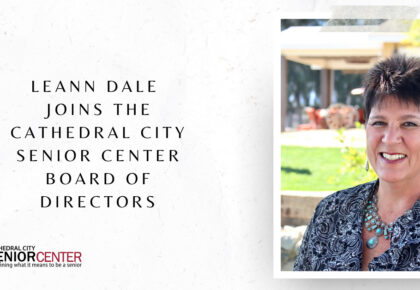
  • Leann Dale Joins the Cathedral City Senior Center Board of Directors

    Leann Dale Joins the Cathedral City Senior Center Board of Directors

    Introducing Leann Dale, CCSC Vice Chair 

    Leann Dale of Senior Living Options of the Desert has joined the Board of Directors of the Cathedral City Senior Center as Vice Chair. “We are thrilled that Leann has joined our Board at this pivotal time”, says Geoff Corbin, CEO of the Cathedral City Senior Center.  “Her experience and leadership in senior housing and senior care will be instrumental in helping us achieve our vision of a 21st century senior center”.

    Leann is President and Owner of Senior Living Options of the Desert which helps families in the Coachella Valley make the best residential care choice for their loved ones. 

    Leann has been instrumental in assisting seniors to find safe, viable living options based on physical, mental & financial needs. She works closely with families to help determine the best choice for each individual situation.  She is a native Californian, born in Glendale, and grew up in the Los Angeles area. She moved to Palm Springs in 1993 where she currently lives with her husband, Ron, and a rescued dog and cat. 

    Leann has worked closely with the Alzheimer’s Association, The Alzheimer’s Walk Committee, the Parkinson’s Resource Organization, Desert Oasis Health Care, and many community-based groups that help seniors find solutions to their needs.


  • What do you do when you get THAT call?

    What do you do when you get THAT call?

    I received this wonderful testimonial the other day from the daughter of one of our clients and I wanted to share it with you. It’s affirming to know that we are making a difference and why I love what I do.

    No one wants to get the call that your parent needs to be moved into assisted living with skilled nursing care. Moreover, when that day comes, most of us are unprepared to make the myriad of decisions that follow.

    I was so fortunate to have been introduced to Leann Dale of Senior Living Options of the Desert. Leann was so professional, kind and caring. She took into consideration our family’s needs and offered us viable options. I want to stress to anyone who is looking for a liaison to assisted living facilities, how important it is to have someone who actually LISTENS. The other national organization that most people would think to call, just gave me lists of assisted living homes, too many of which did not meet my father’s requirements. Moreover, managing their emails (they reach out to you) was overwhelming.

    Leann personally took me to the facilities once we narrowed down the contenders. Not only did she answer my questions, but she asked questions that I might not have known to ask. Leann has been available to me any time I have needed her and even advocated on my father’s behalf to coordinate his release from acute rehab. Her ability and willingness to connect me with additional services has made what is a challenging situation so much more manageable.

    Leann’s integrity is rare in this world of senior living options. I honestly do not know what I and respectively my father would have done without her helping to navigate a world so far removed from my wheel house and in a different city. Even after he was safely ensconced in his new home, she continues to reach out and check in.

    If you find yourself or a member of your family needing to make this kind of move, I strongly encourage you to reach out to Leann Dale 760-322-0322 seniorlivingoptionsofthedesert.com. It will be the smartest and kindest call you can make.

    Jane D.

  • 10 Things You Must Do To Prepare For Older Age!

    10 Things You Must Do To Prepare For Older Age!

    Old age?

    Unfortunately it is one of the last taboo subjects of modern society. We are all aware of it. We all know it will happen one day. But, it’s still one of those topics we don’t dare mention by name.

    And, unless there is a tragic accident, we will all become old.

    Yes, even you!

    Even though we know it’s coming, very few of us will plan for it and just hope it will all work out in the end. Over the next fifty years the number of 65 year old’s living in the US will increase from 46.2 million to just over 98 million. It’s the fastest growing demographic in the US and the one most likely to need some kind of end of life care. It is also been stated that one in three of us will get some form of dementia.
    This means that the responsibility is going to be on you to make sure you’re looked after in your old age.
    There are many steps you can take at every stage of life to help with the situation and make your old age a lot more comfortable for both yourself and your life partner…

    1. Be Organized

    Althought is’s not something you’d like to think about right now, there is a chance that one day a loved one may have to come in and make decisions about your care for you. Try to make things easy for them by being organized. Make sure all your financial documents and plans are in one place. Keep a clear list of everything coming in and out of your household finances, any savings or investments you have, any properties you own and any debts you might have. Knowing exactly what your finances are will be invaluable in sorting your care for you.

    2. Make a Will

    If the worst happens and you die without making a will (called dying intestate) then the law gets to specify how your money will be divided. That means your assets might not necessarily go to those you want them to after you’re gone. If you want to stay in control and decide who gets what, then a will is a must. While it’s possible to draw one up yourself, even a tiny, technical mistake can invalidate it so it’s always a clever idea to get it done professionally. It is worth noting that any will you draw up now might be invalid if you marry/re-marry so make sure you keep it up to date by checking it every five years or so and possibly redrafting it.
    A living will is a document in which you express how you’d want to be treated in different situations in case the time comes when you can’t make your desires known.

    3. Have a What If… meeting

    Just because you’ve decided to tackle your old age head on it doesn’t mean your family and friends will be happy about it. They may think you’re being morbid or worrying about nothing. Or, maybe they’re not ready to tackle the subject. That being said, it is important you have a what if… conversation with your nearest and dearest letting them know exactly what your wishes would be if you became incapacitated or died.

    I have some friends who live alone and worry that something might happen to them. So, they made a pact to call each other every morning just to check in. It gives them peace of mind that someone is checking in on them and it has also created some deep, meaningful relationships.

    4. Organize your power of attorney

    A power of attorney gives a person the authority to act for another person in specified or all legal or financial matters. It is a legal document giving power of attorney to someone.

    If you think you might one day need someone with the power of attorney for you then you should set it up well in advance of when you might need it. You will not be able to do this if, at some point in the future, you are deemed not to have ‘sufficient mental capacity’ (the legal ability to make decisions for yourself). So, do it now while you still can. A power of attorney doesn’t have to be expensive to set up but if a loved one is forced to handle your financial affairs without it will be an even more expensive and complicated process for them.

    5. Set up a pension or an IRA now!

    Many financial experts state that to maintain your standard of living after retirement you’ll need at least 70% of your pre-retirement salary; a figure which rises to 90% for those from lower earning households. With that in mind it’s important to start planning for those additional funds at retirement early.

    If you are currently working and your company has a pension plan, make sure you participate in that. Another option is to establish an IRA (individual retirement account) where you can contribute money each year, up to a legally allowed limit, to the account, investing it as you choose based on your retirement goals.

    6. Plan a Budget

    A good idea, when considering the financial implications of retiring, is to make a retirement budget. What do you plan to be doing? Will you be taking up any new hobbies? How expensive are they likely to be on a monthly basis? Do you have a bucket list you want to work through? Calculating how much you’ll need on a monthly and annual basis for retirement will make a multitude of other decisions you must make easier.

    You should also plan to pay off all you debts before you retire. It may sound like an obvious point but after retirement, unless you’re super prepared, your ability to pay off debts will be vastly reduced compared to while you were working. With that in mind make sure you clear as many as possible while you can. They can also cause problems down the line if you’re trying to get into a care home but debt collection agencies are chasing you for your assets.

    7. Keep working?

    70 is the new 60 is the new….you get the idea. There is nothing that says you have to retire at the age of 60 or 65; in fact that decision could be completely wrong for you.

    Obviously the main question you need to consider is if you can afford to retire. There are many other factors to consider before you make that choice as well, not the least of which is are you mentally prepared to retire? While the thought of not having to get up for work every morning is enticing, it can leave some people angry or depressed with literally no reason to get up in the morning. When planning for retirement make sure you’ve thought about how you’ll fill your days. Will you be taking up a hobby? That’s great, but ask yourself; does it have to wait till you retire?

    Sure you’ll have extra time to spend on it but why put it off? Why not start your plans now, staying physically and mentally active have many benefits, as you’ll see in the next few paragraphs.

    8. Stay healthy and mentally active

    While the majority of the advice discussed so far has centered around your finances, they’re by no means the only thing you need to consider. Looking after yourself by losing weight, quitting smoking, only drinking in moderation and generally staying active will not only mean you live longer to enjoy all your financial planning. You will also improve your ability to remain independent and able.
    It’s not just your physical health you need to look after either. Keeping mentally alert has a range of proven benefits from staving off depression to delaying/slowing down the onset of dementia. For more ideas on this check out The 6 Simple Steps to Keep Your Mind Sharp at Any Age.

    9. Plan for your needs…before they become necessary

    The last thing you need in your old age is stress. Try to envision the kind of needs you might have and deal with them while it’s still easy to do so. Here are some things to consider:

    • Are you still in the family home you’ve been in for the last 20/30 years? Do you still need three bedrooms?
    • Would a smaller house and garden will be much easier to manage as you get older?
    • Should you consider moving closer to family to form an extended support network?
    • Is there anything you can do to the home itself that might make it more navigable as you get older?

    All these things are well worth considering as you reach retirement age.

    10. Make friends

    As we go through life our social networks tend to revolve around either family or work or both. As we get older work friends may drift as we lose touch with them on a day-to-day basis and family might move away or pass on themselves. If you don’t have a wide network of friends you could be setting yourself up for isolation in your old age. Try to take stock of who you know and who you can stay in touch with easily after you retire and extend your range of social activities to widen your social circle(s).


    In Summary

    In spite of all this planning you’re about to do, keep this in mind. You can’t control everything! People get old; it’s an inalienable fact of life and it will happen to all of us. Plan for what you can and then just relax and enjoy your senior years; after all you’ve earned it!

  • What You Should Know About Residential Care Homes

    What You Should Know About Residential Care Homes

    Tucked discretely into regular neighborhoods, residential care homes provide non-medical custodial care for elderly adults. Typically in a single family residence, residential care homes usually serve between two and ten residents, depending on specific state laws. They offer a home-like setting for people who need assisted living but might be intimidated by larger communities.  

    Services Provided in a Residential Care Home

    Also called board and care homes, adult family homes, and residential care facilities for the elderly (RCFE) this is a live-in housing and care option for people who do not have skilled medical needs.  Generally, a residential care home provides the following:

    • A room, either private or shared
    • Meals
    • Varying levels of assistance with daily living activities, such as toileting, bathing, and even money and health care management
    • Custodial care, such as laundry, housekeeping, and transportation to doctor appointments
    • Medication administering.

    These adult family homes are great for people who are looking for a smaller-home-like setting.  They will eat home-cooked meals in the kitchen or dining room.  The home will typically have a front porch or back porch and garden.  And, they will offer lots of one-on-one tender loving care.

    CommunityBoard and Care

    This family-like atmosphere is fostered by a high staff-to-patient ratio, which is typically higher than the same ratio in a nursing home or assisted living community. Most often there is one caregiver for every three or four residents.  

    For seniors who are very active, though, a residential care home may not offer enough stimulation. A larger assisted living community has a wider menu of social activities, such as on-site aerobics or outings to nearby events. A residential care home is a better fit for an individual who can benefit from more individual care.

    What Are The Homes Like

    Just as every house on a block is different, residential care homes are not all styled the same. Some are modest, while others feature crystal chandeliers and granite countertops.  People typically feel more comfortable in a home that resembles one they’ve spent their life in.  The Family Advisors at Senior Living Options of the Desert can help in matching your loved one to a care home that would best suit their needs.  

    Adult family homes are run by all kinds of individuals, from registered nurses to recent immigrants. Sometimes the homeowner lives in the facility, while others are run like a business with shifts of caregivers.  They may have nursing oversight, but the nurse is not onsite at all times.  Because residential care homes vary so greatly, it’s vital to assess the needs of the future resident, deciding if they need around-the-clock staff attention, for example. It’s also important to visit several homes, comparing and contrasting to find the best fit.

    Researching potential adult family homes for loved ones is complicated by the fact that there are no federal standards for these communities. Each state follows its own regulations and licensing rules. (Some states have no set standards.) For states that license residential care homes, surveys on each home are available at local licensing offices. Homes usually must provide this survey if asked by potential clients.  

    What You Can Expect To Pay

    The price tag for a living in a residential care community is often half the cost of nursing home care, and in some states, it is even more affordable than assisted living community care. Although prices vary vastly, care usually costs $3,500 to $4,500 per month, although some cost as little as $1,500 each month. Some charge $5,000 to $6,000 per month; these are typically homes that specialize in dementia care.

    Some long-term care insurance policies pay for residential care home costs. Medicaid-health insurance that helps pay for medical and long-term care for people with low income-often covers fees for people who can’t afford the cost of private care.   Most residences don’t accept Medicaid at all. Since Medicare doesn’t pay for custodial care, it doesn’t usually cover residential care home fees.

    Is a Residential Care Home Right For You?Residential Care Home

    This type of care home is a good fit for many elderly adults. Many of them can provide care until the end of a life, and helps residents feel like they are living in their own homes.  

    Please contact a Family Advisor at Senior Living Options of the Desert for more information.  Our services are always free.


    About Senior Living Options of the Desert

    Senior Living Options of the Desert is Southern California’s leader in senior living referral. We’ve been helping families find compassionate care for their loved ones since 2004.

    Whether you’re looking for independent living, assisted living, memory care, or another form of senior care, our local family advisors will help you find the right option for you and your family. Our mission is to provide families with the best residential care options based on care needs and location, no matter what the budget. And, our services are always FREE.

    You can get more information at www.seniorlivingoptionsofthedesert.com.

  • Care About Care?  Let’s Talk About Care Options

    Care About Care? Let’s Talk About Care Options

    Please join us for this very important seminar


    WHEN HOME ALONE IS NO LONGER AN OPTION:

    Everything You Need To Know About Long-term Care and Costs That You Were Afraid To Ask

    The LGBT Center of the Desert
    1301 N Palm Canyon Drive 3rd floor, Palm Springs
    Saturday, October 19, 2019
    9:30 AM – 11:30 AM

    Speakers:

    Leann Dale, President, Senior Living Options of the Desert
    Dr. Suzanne Karefa-Johnson, MDFamily Hospice Care

     Please reserve your place by replying to this email or
    calling 323-533-3550.

    Most Americans will require long-term care

    According to https://longtermcare.acl. gov/the-basics, most Americans will require long-term care regardless of age.  Join us for an important seminar clarifying the options for care, the costs of care, the details of hospice care, and finally, how care is paid for.


  • How Do You Know When It’s Time For Assisted Living?

    How Do You Know When It’s Time For Assisted Living?

    If you’re a caregiver, you most likely wonder if there are certain signs or signals that might indicate when the time is right to consider assisted living for your loved one.  If you are starting to think about it, you are more than likeley feeling the challenge of balancing everything that is going on in your life and are starting to feel overwhelmed.  It might be time to consider some assistance.  But, how do you know when it’s time for assisted living?

    Let’s First Address EmotionsCaregiver Stress

    Families often experience a lot of guilt and anxiety at the very thought of considering placing their loved in in an assisted living facility.  Many have even promised their loved ones years ago that they would never place them in a “home”.  And, many people feel that it is their duty to care for their loved one at home.  I’m sure you’ve heard people say, “Mom took care of me, now it’s my turn to take care of her.”

    Then, there are those who have had a bad experience (or have heard of someone who had a bad experience) with a facility and are afraid of making that decision.  The most common fear or concern is that their loved one will not be cared for as well as they are at home or that placement in a facility will cause them to decline faster.  Quality of life is a huge factor for most families when considering assisted living.  

    Many Times It’s Out Of Your Control

    Occasionally, the decision to place someone in a facility is out of your control.  There may be sudden situations when it’s clear that the time has come for assisted care. These can include:

    • Severe illness
    • Injury
    • Hospitalization/death of the caregiver
    • Hospitalization of the person who needs care
    • Dementia

    These abrupt changes often necessitate immediate placement in a facility. Sometimes, a loved one may end up in a facility almost overnight, with little time to research options.  I get calls all the time from families who have experienced one of these events and have to find a facility immediately.  

    When Do You Know It’s Actually Time?Senior Living Options of the Desert

    Outside of the above sudden situations when it’s out of your control, how do you know when you should consider looking in to assisted living for your loved one?  

    The 13 Signs To Consider:

    1. You’ve injured yourself (such as hurting your back or falling) when trying to lift or move your loved one.
    2. If your loved one has Alzheimer’s and it has progressed to the point where they try to hurt you.  Or, they exhibit other challenging behaviors such as paranoia or anger.  
    3. Your family member has wandered off outside the home and/or has become lost.  
    4. You are falling short of your other responsibilities.  
    5. You exhibit signs of caregiver burnout.  For example, you recently lost your temper when your loved one was resisting getting dressed.  Or, they were following you everywhere you went inside the house.  
    6. Your own health is declining.  This can be either physical or emitional and may include conditions such as high blood pressure, headaches, stomach problems, anxiety, and depression. 
    7. Your relationships are significantly suffering. 
    8. You have surgery or another planned medical procedure coming up.
    9. Your doctor has said that it’s time for assisted living for your loved one.  
    10. Your loved one has care needs that you really can’t handle well, despite your best efforts.
    11. Friends or other family members have expressed concern for you and have encouraged you to look in to other care options for your loved one.
    12. You have tried other in-home care resources but they just aren’t providing enough assistance for you.  
    13. When you determine that assisted living is more cost-effective than what you are paying for in-home care assistance.

    If one or more of these signs sounds familiar, it may be time to look in to a move to an assisted care facility.  You can talk with people you know who might be able to recommend a facility in your area.  Or, you can utilize a free assisted living placement service like Senior Living Options of the Desert who can guide you through the process.    They can save you hours and hours of time researching the best options for you. 

    A Word From Senior Living Options of the Desert

    Thinking about care options for your loved one can be stressful. Although sometimes it feels like you can manage it, there may be other times where you feel like you’re just not able to do it all.

    Many people describe the feeling as if they are drowning in the responsibility and the weight of the caregiver role.  Acknowledging these feelings, however, does not take anything away from the love you have for the person you are caring for.

    Your health and well-being are important in being able to care for your loved one.  Acknowledging that you can’t do everything is ok.  Planning ahead will help you to be there for your loved one and allow you to continue to provide the support they need during the challenges of this journey.  

  • How To Pay For Assisted Living

    How To Pay For Assisted Living

    The cost of Assisted Living Facilities in California can vary from $3,000 – $10,000 per month. The statewide average as of 2018 was $4,070/month. Sometimes people have a false sense of security about what their insurance will pay. It’s important to know right up front that Medicare will not pay for assisted living. But, don’t get discouraged. There are some other options you can investigate.

    You may be able to navigate some of these options yourself. Some senior living communities offer a “financial concierge service” that may be able to help guide you through the process of qualifying for financial benefits. Another option is to speak with a “geriatric planner”. They can save you a lot of time and have a wealth of knowledge in this area. However, if you cannot afford or cannot find a geriatric planner, with a little determination and perseverance you can achieve the same results. Here are the most common ways people pay for Assisted Living. Let’s check them out.

    Long Term Care Insurancelong term care insurance

    If you have a Long-Term Care insurance policy, it should cover assisted living as well. If your policy is designated for home care, you should be able to use it for assisted living too. There are also “facility-only” policies that cover care only in a licensed assisted living or skilled nursing facility.

    Most insurance policies are difficult to understand. It’s important to know what your benefits are so you can ensure you get what you’ve paid for. It is common for insurance companies to decline payment on the first go round. But, don’t let this deter. Many times you, or an advocate at the assisted living facility, will need to contact the insurance company and discuss these issues in order to get approval. Most insurance companies required that you need help with at least two ADL’s (Activities of Daily Living) such as bathing, eating, dressing, transferring from bed to chair, walking, and toileting.

    Long Term Care insurance plans and their respective benefits vary widely depending on the policy. Benefits can range from $1,500 to more than $9,000 per month.

    life insurance

    Life Insurance

    Most people think of life insurance as funds that are not available until after the person’s death. But a life insurance policy can provide financial support now if you need funds. There are several ways that your policy may be used to pay for care while the person is still alive. Ask your Life Insurance Agent about cashing out the policy. They are often referred to as accelerated or living benefits. Typically a company will purchase the policy back for 50 to 75 percent of its value. The rules will be different depending on the company and type of policy. Some policies can only be cashed in if the policyholder is terminally ill while others are much more flexible.

    If the company won’t let you cash it in, you may be able to sell the policy to a third-party company in return for a “life settlement” or “senior settlement”. In this case you can typically expect to receive 50 to 75 percent of the policy’s face value. The third party company will continue to pay the premiums until the policyholder dies at which tie the company received the benefits.

    There are also options called “life assurance” benefits or life insurance conversion programs. These will allow seniors to switch the life insurance policy into long-term care payments. Life insurance conversion typically pays between 15 and 50 percent of the value of the policy. Although this is less than a life settlement, it is an option for lesser-value policies that might not qualify for life settlement.

    Veterans Benefits

    The VA (Veteran’s Administration) can be very generous when taking care of those who served. If you or your loved one is a veteran, you may be eligible for benefits that can be used to pay for residential care. These benefits are known as Aid and Attendance benefits.

    Aid and Attendance benefits are available to veterans, and/or their surviving spouse, who are disabled and whose income is below a certain limit. A veteran must have served at least 90 days on active duty and/or at least one day during wartime (a period of active conflict). The medical condition doesn’t need to be related to your service but you must meet medical qualifications. The average maximum benefit is typically $1,949 a month for married veterans, $1,644 for single veterans and $1,056 for a surviving spouse.

    If you are told that you have too many assets to qualify for this program, you may be able to make some re-allocations or adjustments to your assets without being penalized. Anytime a person tries to “safeguard” their finances or assets, it can be quite tricky. You must make absolutely sure that doing this does not affect eligibility. Ask questions more than once to make sure you understand what to do.

    In order to qualify, you will need to apply through the Veteran’s Administration. In addition to your military discharge papers, you will need to provide a letter from your doctor indicating a valid medical condition that makes you appropriate for assisted living.

    Consider Selling or Renting Your Home

    If you own your home and nobody needs to remain in the home, this can be a valuable resource. Selling a family home is a difficult decision for many people to make and some aren’t quite ready to take that step right away. If that’s the case, consider renting the home which will give you a monthly income that could cover the cost of assisted living.

    Reverse Mortgage

    If you own your own home and your spouse still needs a place to live, a reverse mortgage might be just the option for you. A reverse mortgage allows you to borrow money on the equity you have built up in your home. Then, when the last person is gone from the home, the money needs to be repaid which usually means selling the home. As with any major financial decision, make sure you do your homework and understand what you are getting in to. It is a viable option for many but not for everyone.

    Bridge Loan

    If you have trouble liquidating assets quickly, a short term loan may be able to help bridge the gap. These loans are typically available up to $50,000 and designed to fund the move to an assisted living facility. They are usually used while waiting for the sale of a property or while waiting to be approved for a pension.

    Private Pay

    Personal income or savings is the simplest route to pay for assisted living, but the cost can quickly deplete your savings. If you have investment portfolios such as a 401k or an IRA, you may want to consider cashing in on those. Often paying out-of-pocket is beyond what many can afford for very long. However, when all your resources have been exhausted, you can apply for Medicaid.

    Annuity

    If you have a sizable savings but are worried about outliving your resources, you may wish to consider an annuity. With an annuity, you pay a lump sum to an underwriter and then you receive regular payments over a specified period (usually for the rest of your life).

    This is one way you can stretch out your money and make sure that you will always have some money coming in even if you live longer than expected. The benefit of an annuity is that you may bet back more money than you put in. The underwriters hope to make a profit off you if you die early. They take the risk that you could live longer. It can be more beneficial for you than just spending your money on the cost of the stay. Annuities can be complex so always consult with a financial adviser to assist you.

    Conclusion

    I hope this has given you some options to consider when deciding how to pay for assisted living. If you have any questions, please feel free to contact me. If I can’t answer your question I can put you in touch with the right resource who can.

  • Socialization in Assisted Living Can Improve Senior Health

    Socialization in Assisted Living Can Improve Senior Health


    As we age, it’s normal to lose social connections along the way. According to Greater Good Science Center at UC Berkeley, we lose ‘social capital’ as we age.  This is usually due to retirement, friends and family members moving away, or losing them to illness and death.  

    This normal decrease in daily social contacts has a negative impact on our health, both physical and mental.

    Fortunately, there are ways to change this. Friendships and regular socialization improve overall health.

    A study published in The Journals of Gerontology found that senior assisted living communities that are well-designed can improve socialization, happiness, and quality of life. Providing your older adult with more opportunities to be social, like living in an assisted living community, may help them thrive.

    The benefits of socialization for seniors

    Being social has a significant influence on senior health and well-being. Many studies have shown that there are positive effects of socializing for seniors, including:

    Improved mental health

    Older adults often experience cognitive decline or the symptoms of depression. Studies show that more than 7 million seniors are dealing with symptoms of depression.

    There are other studies that show consistent interaction with people helps   reduce the risk of depression and dementia in older adults.

    Better nutrition

    When seniors live alone they are more likely to suffer from malnutrition.  Friendly, lively social interactions with others can improve appetite, nutrition and overall health in older adults.

    Improved physical health

    A socially active life can also have additional health benefits – less physical pain, lower blood pressure, and even a better immune system.  

    Loneliness can increase health risks

    According to Seniorly, older adults who live at home may still be dealing with loneliness. Even with in-home care, they may not be getting the amount of contact and communication they need.

    Forbes reports that loneliness could be even a bigger health risk than obesity or smoking.  There is another study showing that social isolation increased the risk of death by as much as 30%.  Seniors who are isolated socially often experience higher mortality rates as well.  

    For many aging adults, the key to increasing socialization may be to attend an adult day program, move to an assisted living community, or consider another type of senior housing.

    Assisted living communities help increase socialization

    Assisted living communities make it easier for residents to socialize with their peers.

    There are plenty of common areas where people can gather as well as structured activities like games, cultural events, dancing, field trips, and more.

    The New York Times reported that levels of loneliness and social isolation are growing among seniors and it’s taking a toll on physical and mental health. The article notes that many elders benefited from living in retirement communities because of the shared activities, convenience, and larger number of potential friends with similar interests.


    About Senior Living Options of the Desert

    Senior Living Options of the Desert is Southern California’s leader in senior living referral. We’ve been helping families find compassionate care for their loved ones since 2004.

    Whether you’re looking for independent living, assisted living, memory care, or another form of senior care, our local family advisors will help you find the right option for you and your family. Our mission is to provide families with the best residential care options based on care needs and location, no matter what the budget. And, our services are always FREE.

    You can get more information at www.seniorlivingoptionsofthedesert.com.